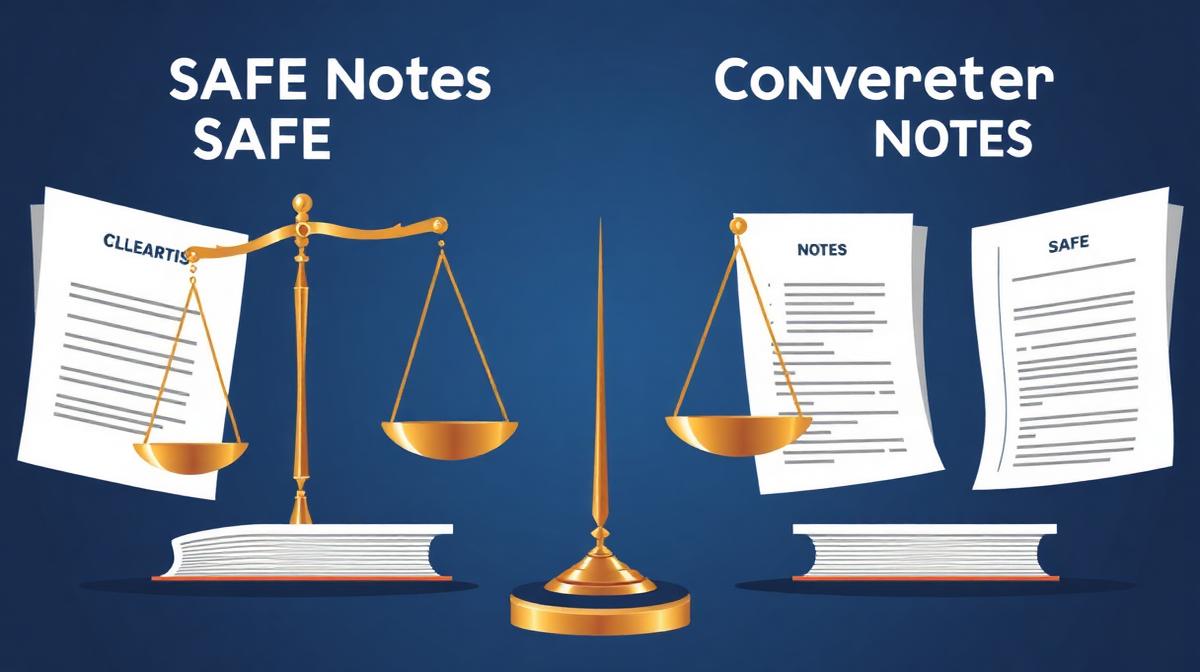
When raising your first round of funding, you'll inevitably face the question: SAFE or convertible note? For Israeli founders navigating the US fundraising landscape, this decision has implications beyond just the legal terms — it affects your cap table, your Israeli tax reporting, and your relationship with future investors.
What Is a SAFE?
A SAFE (Simple Agreement for Future Equity) was created by Y Combinator in 2013 to simplify early-stage fundraising. Key characteristics:
- Not debt: SAFEs are not loans. They don't have interest rates, maturity dates, or repayment obligations
- Convert on trigger event: SAFEs convert to equity when a priced round occurs
- Valuation cap and/or discount: Investors get a better price than the priced round investors through a cap (maximum valuation for conversion) or discount (percentage off the round price), or both
- No board seat: SAFEs typically don't come with board representation
- Simple documentation: Usually 5-6 pages, standardized by YC
What Is a Convertible Note?
A convertible note is a debt instrument that converts to equity. Key characteristics:
- It's debt: Has a principal amount, interest rate (typically 2-8%), and maturity date (usually 18-24 months)
- Converts or gets repaid: At maturity, either converts or must be repaid (in practice, usually renegotiated)
- Valuation cap and/or discount: Same conversion mechanics as SAFEs
- More complex: Includes debt-related provisions like default, acceleration, and subordination
- Creditor rights: Note holders have creditor rights, meaning they're ahead of equity holders in liquidation
Head-to-Head Comparison
Speed and Cost
- SAFE: Faster to close, lower legal costs ($0-2,000). Standard YC template is widely accepted
- Convertible Note: More legal work ($2,000-5,000), more negotiation points
Cap Table Impact
- SAFE (post-money): The modern YC post-money SAFE makes cap table math straightforward — the investor's ownership is simply their investment divided by the cap
- SAFE (pre-money): Older SAFEs are pre-money, making dilution harder to calculate
- Convertible Note: Interest accrual means the conversion amount grows over time, creating more dilution than initially expected
Israeli Tax Implications
This is where it gets complex for Israeli founders:
- SAFEs: The Israeli Tax Authority (ITA) doesn't have a clear, definitive ruling on SAFEs. They may be treated as equity (triggering different tax events) or as a form of forward contract. Get tax advice before signing.
- Convertible Notes: The ITA generally treats these as debt instruments. Interest may have withholding tax implications. At conversion, there may be a taxable event depending on the structure.
- Section 102 interaction: If you're granting employee stock options under Section 102, the SAFE/note structure can affect the trustee arrangement and tax treatment.
What Happens at Maturity (Notes Only)
If your convertible note hits its maturity date before you raise a priced round:
- Best case: The investor agrees to extend
- Okay case: The note converts at the cap
- Bad case: The investor demands repayment (rare but possible)
- Worst case: The investor declares default and accelerates all notes
This maturity "cliff" doesn't exist with SAFEs, which is one of their biggest advantages for founders.
When to Use Each
Use a SAFE When:
- You're raising a small pre-seed round ($100K-$2M)
- Speed matters more than precision
- You're raising from angels or micro-VCs familiar with SAFEs
- You want to avoid debt on your balance sheet
- You're planning to raise a priced round within 12-18 months
Use a Convertible Note When:
- Your investors require a debt instrument (some Israeli investors prefer this)
- You need a maturity date to create urgency for the next round
- Tax considerations favor debt treatment in your specific situation
- You're raising from investors who are less comfortable with SAFEs
- There are regulatory reasons requiring a debt instrument
Common Mistakes Israeli Founders Make
- Stacking too many SAFEs: Each SAFE dilutes you at the next round. Track your total SAFE obligations carefully.
- Ignoring the post-money vs. pre-money distinction: Post-money SAFEs include the option pool in the cap; pre-money don't. This can be a 15-20% difference in dilution.
- Not getting Israeli tax advice: The interaction between US fundraising instruments and Israeli tax law is nuanced. Don't assume your US lawyer has this covered.
- Forgetting to update your cap table: Every SAFE and note should be reflected in your cap table immediately, not when conversion happens.
- No clean-up before priced round: Unresolved SAFEs and notes create due diligence headaches. Clean them up proactively.
How Aleph Accounting Helps
We help Israeli founders understand the financial and tax implications of their fundraising instruments — in both Israel and the US. From cap table modeling to tax planning around SAFE and note conversions, we make sure your early fundraising decisions don't create expensive problems later.
Frequently Asked Questions
What Is a SAFE?+
What Is a Convertible Note?+
When to Use Each?+
Analyze this article with AI:
Ready to level up your startup finances?
Schedule a free consultation with our team to discuss your specific needs.
Schedule a Call